Updated Article: Complete Guide to SEO Vs. SEM
SEO vs SEM Feature Comparison
| Feature | SEO | SEM |
|---|---|---|
| Cost Structure | No per-click costs | Pay per click |
| Time to Results | Long-term (3-6 months) | Immediate |
| Sustainability | Long-lasting value | Requires continuous spend |
| User Trust | High organic trust | Lower ad skepticism |
| Control | Algorithm dependent | Direct control |
The Case for SEO
Sustained Value: Well-executed SEO delivers compounding returns that build momentum over time, while SEM requires continuous investment to maintain visibility and traffic flow.
Trustworthiness: Organic search results carry inherent credibility with users, who understand these positions are earned through relevance and authority rather than purchased placement.
Cost Efficiency: SEO requires strategic investment in content and optimization but eliminates the ongoing cost-per-click expenses that can quickly consume marketing budgets in competitive markets.
SEO vs SEM Analysis
SEO Vs. SEM
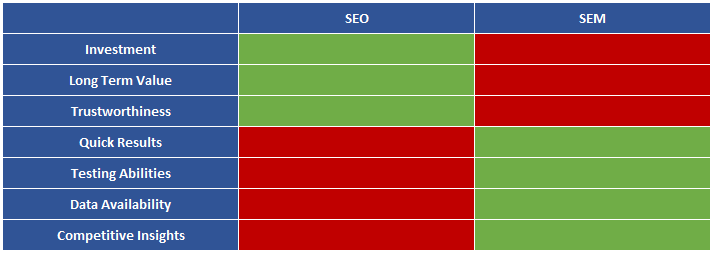
SEO vs SEM Feature Comparison
| Feature | SEO | SEM |
|---|---|---|
| Cost Structure | No per-click costs | Pay per click |
| Time to Results | Long-term (3-6 months) | Immediate |
| Sustainability | Long-lasting value | Requires continuous spend |
| User Trust | High organic trust | Lower ad skepticism |
| Control | Algorithm dependent | Direct control |
SEO
Search Engine Optimization (SEO) is the strategic practice of enhancing your website's visibility and ranking in organic search results. In today's digital landscape, search engines have become the primary gateway for information discovery and purchasing decisions. Google processes over 8.5 billion searches daily as of 2026, making search visibility critical for business success. When users need answers, products, or services, they instinctively turn to search engines, creating countless opportunities for businesses to connect with their target audience.
The competition for search visibility has intensified dramatically. Every query represents a moment when multiple businesses compete for user attention, making strategic SEO implementation essential for sustainable growth. Companies that master SEO fundamentals—technical optimization, content strategy, and authority building—position themselves to capture this valuable organic traffic consistently.
SEO vs SEM Analysis
SEM
Search Engine Marketing (SEM) operates alongside organic results on search engine results pages (SERPs), offering businesses immediate visibility through paid advertisements. While SEO builds long-term organic presence, SEM provides instant positioning for targeted keywords through strategic bidding and ad placement.
The fundamental distinction lies in the payment model: SEM requires payment for each click generated, while SEO focuses on earning traffic through content relevance and site authority. Both strategies target the same valuable real estate—the search results page—but employ different mechanisms to achieve visibility.
Search Results Example
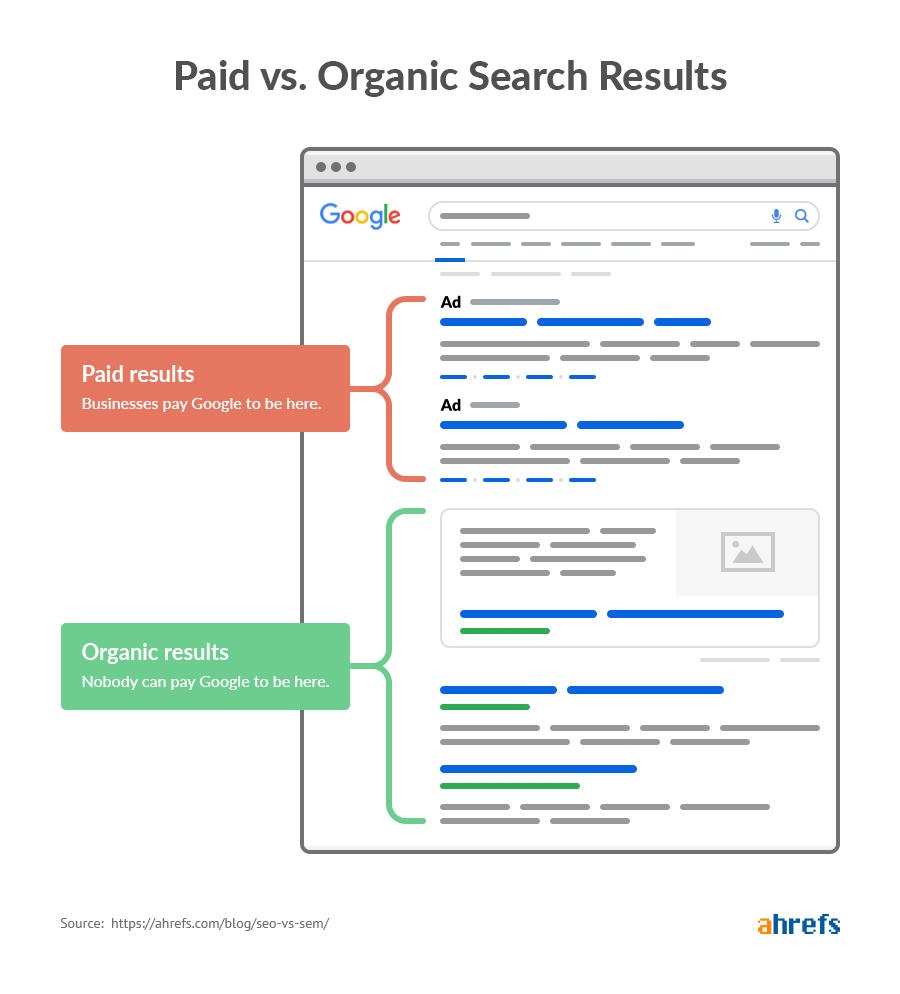
Understanding SERP layout is crucial for digital marketers. Below is a typical search result where the top positions are clearly marked as advertisements, followed by organic listings that have earned their placement through SEO efforts.
SEO vs SEM Feature Comparison
| Feature | SEO | SEM |
|---|---|---|
| Cost Structure | No per-click costs | Pay per click |
| Time to Results | Long-term (3-6 months) | Immediate |
| Sustainability | Long-lasting value | Requires continuous spend |
| User Trust | High organic trust | Lower ad skepticism |
| Control | Algorithm dependent | Direct control |
Comparison
Choosing between SEO and SEM requires understanding your business goals, timeline, and resources. While integrated search strategies combining both approaches often yield optimal results, there are compelling reasons to prioritize SEO as your foundation. The following analysis examines three critical advantages of emphasizing SEO in your digital marketing strategy.
1. Sustained Value
SEO's most significant advantage lies in its compound growth potential. Unlike SEM's pay-per-click model, SEO investments accumulate value over time, creating what marketers call "digital assets." High-quality content, technical optimizations, and earned backlinks become permanent fixtures that continue generating returns long after the initial investment.
This sustained value manifests in multiple ways. A well-optimized website with strong domain authority can maintain top rankings for years, generating consistent traffic without ongoing advertising costs. Moreover, established SEO success creates expansion opportunities—a website with authority in automotive sales, for example, can more easily branch into related verticals like automotive financing or insurance, leveraging its existing search engine credibility.
The compounding effect becomes particularly powerful as your content library grows and your domain authority increases. Each piece of optimized content supports overall site performance, creating a robust foundation that becomes increasingly difficult for competitors to replicate.
2. Trustworthiness
Consumer behavior studies consistently demonstrate higher trust levels for organic search results compared to paid advertisements. Users understand that organic rankings represent earned positions based on relevance, authority, and user satisfaction signals that search engines use to determine quality.
This trust differential has become more pronounced as consumers become increasingly sophisticated about digital marketing tactics. Modern users often skip past advertisement sections entirely, focusing their attention on organic results they perceive as more credible and unbiased. For businesses building long-term brand authority, this organic visibility serves as a powerful trust signal that reinforces credibility across all marketing channels.
The trust factor extends beyond individual clicks to overall brand perception. Companies consistently appearing in top organic positions for industry-relevant searches establish thought leadership and expertise recognition that enhances their market position.
3. Cost
While SEO requires significant investment in strategy, content creation, and technical implementation, it eliminates the ongoing cost-per-click expenses that characterize SEM campaigns. In competitive industries where popular keywords can cost $50-200 per click, this difference becomes substantial quickly.
For businesses operating with limited marketing budgets, SEO offers a path to compete with larger competitors without matching their advertising spend. A well-executed SEO strategy can generate traffic volumes that would cost tens of thousands of dollars monthly through paid advertising, making it particularly attractive for emerging businesses or companies in cost-sensitive industries.
The economic advantage compounds over time. While SEM costs accumulate linearly with traffic volume, SEO costs remain relatively fixed while traffic potential grows, creating increasingly favorable return on investment as your search presence strengthens.
Tiger King
Real-world SEO competition can be surprisingly intense, as demonstrated in unexpected places like Netflix's "Tiger King" documentary. Episode 4 highlighted how Joe Exotic understood SEO's value enough to create domain names similar to competitors, attempting to capture traffic from their established search presence. His rival's obsession with maintaining the top position for "big cat rescue" searches illustrated how valuable that organic visibility had become for their organization's success.
This example underscores an important point: SEO value extends far beyond traditional business sectors, and the competitive advantages it provides are significant enough to drive strategic decisions across diverse industries.
Three Primary Benefits of SEO Over SEM
Sustained Value
SEO investments in technical optimization, content, and backlinks create lasting website value. Good SEO continues driving traffic long after initial work is completed.
Enhanced Trustworthiness
Users generally trust organic search results more than paid advertisements. Organic rankings signal that content earned its position through relevance and quality.
Cost Effectiveness
While SEO requires time and effort, it doesn't accumulate per-click costs like SEM. This makes it especially valuable for businesses with limited advertising budgets.
Established SEO authority in one market segment makes expansion easier. A respected car buying website has inherent advantages when entering related markets like car rentals due to existing domain authority.
Master SEO & Digital Marketing
Google performs billions of searches daily, making search engine optimization crucial for business visibility. Every search represents potential customers looking for products, services, or information.
Core SEO Components
Technical SEO
Optimize website structure, loading speed, mobile responsiveness, and crawlability to help search engines index your content effectively.
Content Creation
Develop relevant, valuable content that addresses user search queries and demonstrates expertise in your industry or niche.
Link Building
Earn high-quality backlinks from authoritative websites to establish credibility and improve search engine rankings.