To accurately calculate an investment's net present value (NPV), you must first master the concept of the discount factor—arguably the most critical component in discounted cash flow (DCF) analysis. The discount factor represents the present value of money that will be received in the future, accounting for the time value of money principle that forms the bedrock of corporate finance.
Every discount factor calculation operates on a fundamental economic reality: a dollar today is worth more than a dollar tomorrow. This deterioration in purchasing power stems from multiple factors—inflation, opportunity cost, and inherent investment risk—which collectively ensure the discount factor always falls between zero and one. The closer to one, the less time or risk involved; the closer to zero, the more distant or uncertain the future cash flow becomes.
Now that we've established the theoretical foundation, let's examine the practical application. Here's how you can leverage the discount factor to transform projected Free Cash Flow (FCF) and Terminal Value (TV) into a comprehensive Enterprise Value calculation:
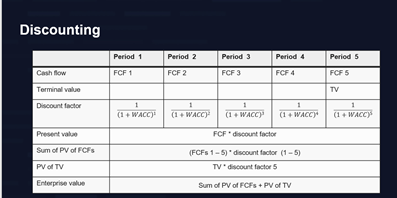
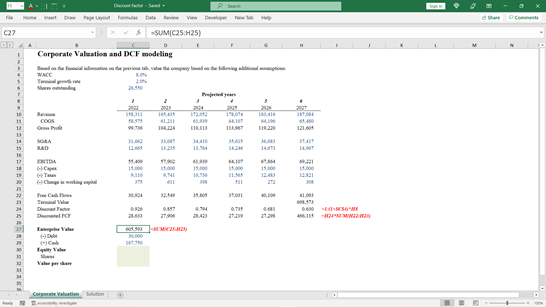
The mathematical execution follows a straightforward three-step process. First, we calculate the discount factor using the formula: =1/(1+$C$4)^C8. This formula divides one by the discount rate (typically your Weighted Average Cost of Capital) raised to the power of the time period, giving us the present value multiplier for each future year.
Next, we apply this discount factor to our projected cash flows and terminal value: =C24*SUM(C22:C23). This step converts those future dollars into today's equivalent value, accounting for both the time delay and the risk inherent in achieving those projected returns.
Finally, we aggregate all discounted values to arrive at our Enterprise Value: =SUM(C25:H25). This sum represents the total economic value of the business based on its projected ability to generate cash flow over time.